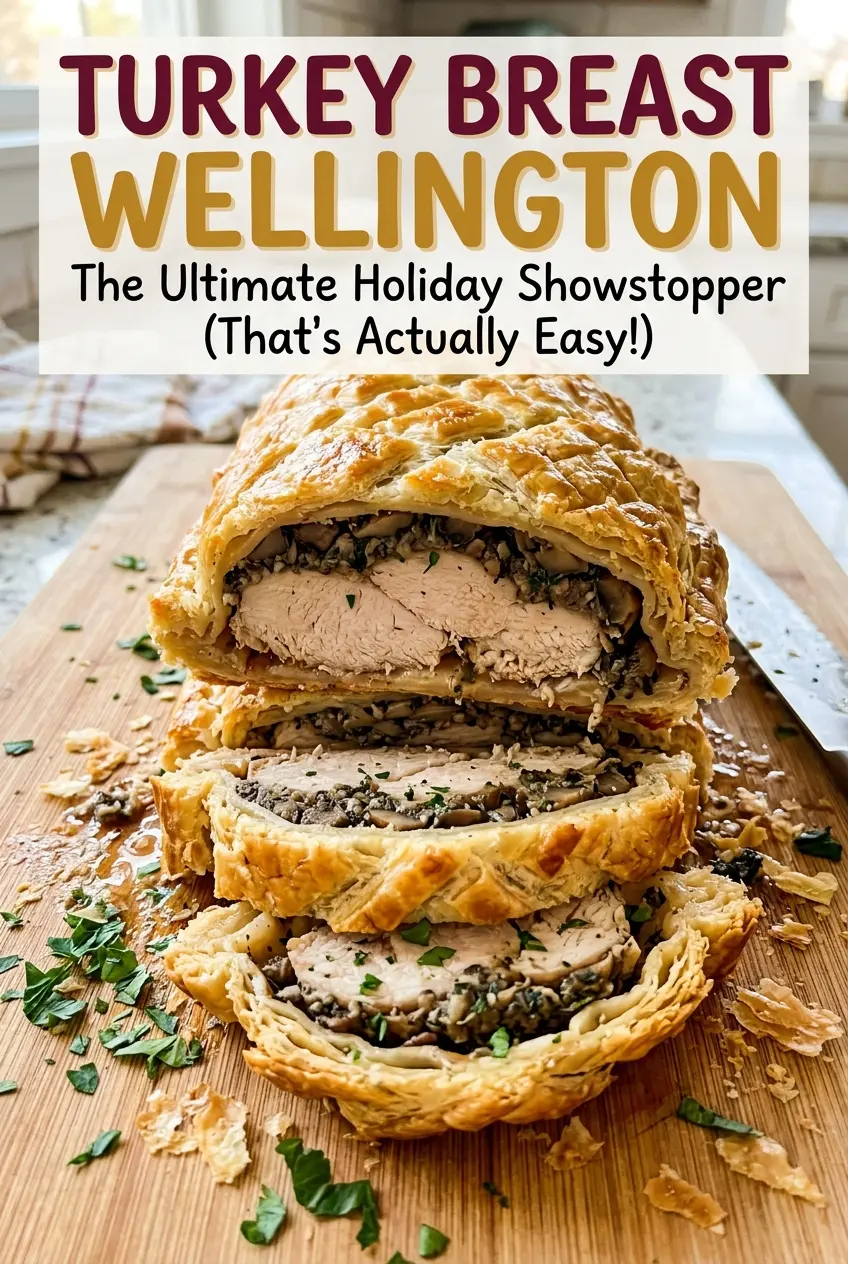
When the pastry edges start turning golden, the turkey still needs time in the oven. That’s part of what makes Turkey Breast Wellington worth watching: flaky pastry wraps around prosciutto, a savory mushroom layer, and a tender turkey roast, but the crust can brown before the center is ready. I rely on a thermometer rather than the color of the pastry to tell me when it’s done.
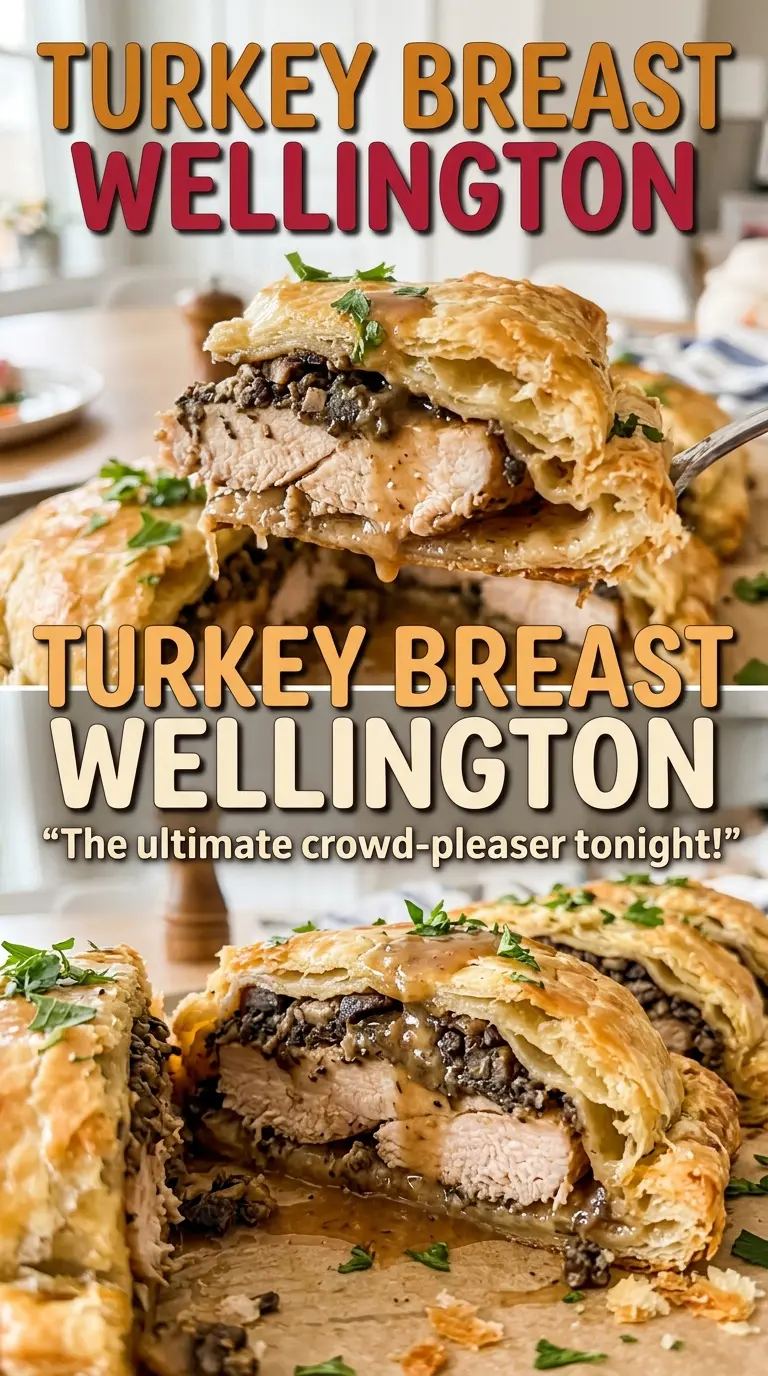
The layers each have a job, and the order matters. I sear the turkey first for a browned exterior, then let it cool completely while the mushroom duxelles cooks down in the same skillet. Wrapped snugly and baked inside thawed puff pastry, the roast slices into a lovely cross-section with a crisp outside and a moist, savory center.
Kitchen Note
Roll the puff pastry while it’s pliable but still cool. If it turns warm and floppy, it’s harder to seal neatly around the roast, so take your time getting the turkey bundle ready first.
Save this Turkey Breast Wellington for a centerpiece-worthy meal with crisp pastry, prosciutto, and savory mushroom duxelles.
Why the Prosciutto Has to Enclose the Mushroom Layer
Prosciutto does more here than add a salty, savory bite. It forms the layer between the mushroom duxelles and the puff pastry, helping keep the filling gathered around the turkey instead of pressed directly against the pastry. That separation matters because pastry needs room to bake into distinct, flaky layers; a damp filling right against it can leave the bottom soft.
The prosciutto also makes the turkey bundle easier to handle before it goes into the pastry. Overlapping slices create one continuous wrap, so the duxelles stays tucked around the roast when you lift and turn it. Thin slices are easier to overlap than thick ones, and the plastic wrap helps you snug the whole layer into place without pulling the prosciutto apart. Keep the wrap close to the turkey rather than leaving loose folds, which can make the finished slices uneven.
There’s a balance to the seasoning, too. Prosciutto brings salt to every slice, while the turkey and mushrooms are seasoned separately. That’s why I stick with the measured salt in the filling rather than salting the prosciutto layer again.
What Each Wellington Layer Adds to the Finished Slice
- Turkey breast roast — A boneless, skinless roast gives you a compact shape that fits inside a pastry sheet and slices neatly for six servings. Patting it dry helps the surface brown in the skillet instead of steaming. Choose a roast with an even shape so it cooks more evenly.
- Cremini mushrooms — Their earthy flavor gives the duxelles a savory depth. Chop them finely so they spread in a thin, even layer. White button mushrooms work in the same amount if that’s what you have; the flavor will be a little milder.
- Fresh thyme and shallot — Thyme gives the mushrooms a woodsy note, while shallot softens into the butter without overpowering the filling. Fresh thyme leaves have a brighter taste than dried; if you need to use dried thyme, use about one-third as much.
- Dry white wine — A dry wine adds a gentle acidity and loosens the browned bits in the skillet as it cooks away. Avoid a sweet wine, which can leave the mushroom mixture tasting sweeter than intended. For a no-alcohol version, leave it out and continue with the mushrooms until the pan is nearly dry.
- Prosciutto — Thin slices overlap and wrap more cleanly than thick-cut slices. A good-quality, thinly sliced prosciutto is useful here, but there’s no need to seek out an expensive specialty cut; the pastry and duxelles bring plenty of character.
- Puff pastry and egg — Use one thawed sheet so it can roll around the roast without cracking. The beaten egg and water make the surface glossy and encourage an even golden finish; score lightly so the top is decorated without cutting through the pastry.
From a Browned Roast to a Sealed, Golden Wellington
Sear the roast, then cool it completely
Season the turkey all over with 1 teaspoon of the kosher salt and the black pepper. Heat the olive oil in a 12-inch skillet over medium-high heat, then turn the roast as it sears for 6–8 minutes, browning all sides. Transfer it to a plate and refrigerate until completely cool, about 30 minutes. The sear builds color on the outside; the center will finish cooking in the oven.
Cook the duxelles until the pan is nearly dry
Melt the butter in the same skillet over medium heat and add the minced shallot. Stir for 2–3 minutes, until it softens, then add the finely chopped mushrooms, thyme, and remaining 1/4 teaspoon salt. Cook for 10–12 minutes, stirring often, until the mushrooms release their liquid and the pan is nearly dry. Add the wine and stir for 2–3 minutes, until that liquid has evaporated, then spread the mixture on a plate to cool completely.
Wrap the turkey in prosciutto
Arrange overlapping prosciutto slices into a rectangle on plastic wrap, then spread the cooled duxelles over them. Set the turkey in the center and use the plastic wrap to snug the prosciutto around the roast. The wrap should hold the bundle together, not stay inside it; unwrap the chilled bundle after 15 minutes in the refrigerator.
Seal the pastry and bake to temperature
Heat the oven to 400°F and line a rimmed baking sheet with parchment paper. On a lightly floured surface, roll the thawed pastry into a rectangle large enough to enclose the turkey, set the roast seam-side down in the center, and fold the pastry around it, sealing the seams. Brush the pastry with the egg beaten with water and score the top lightly. Bake for 45–60 minutes, until golden brown and a thermometer inserted through one end into the turkey’s center reads 165°F; if the pastry browns first, tent it loosely with foil, then rest the Wellington for 10 minutes before slicing.
Three Ways to Adapt Turkey Breast Wellington
Make it gluten-free
Use a gluten-free puff pastry sheet and gluten-free flour for rolling. The pastry may be more delicate than wheat pastry, so roll it gently and avoid stretching it around the roast; the finished layers may be less lofty but still make a crisp casing.
Make it dairy-free
Replace the butter with the same amount of olive oil and use puff pastry made without dairy. The mushrooms will still cook down into a savory filling, though the duxelles will lose the round, buttery flavor.
Skip the wine
Leave out the dry white wine and cook the mushrooms until their released liquid has evaporated and the pan is nearly dry. You’ll miss the wine’s light acidity, but the shallot, thyme, and mushrooms still make a satisfying duxelles.
Storage and Reheating
- Refrigerator: Refrigerate leftovers within 2 hours and keep them covered for 3–4 days. The pastry softens as it sits.
- Freezer: Freeze tightly wrapped slices for up to 2 months for best quality. Thaw them overnight in the refrigerator; the pastry will be softer than when freshly baked.
- Reheating: Warm slices on a baking sheet in a 325°F oven until steaming hot throughout. The microwave heats the turkey quickly but leaves the pastry soft.
Questions That Come Up Before Slicing
Turkey Breast Wellington
Ingredients
Equipment
Method
- Sprinkle the turkey all over with 1 teaspoon of the salt and the black pepper.
- Heat the olive oil in a 12-inch skillet over medium-high heat, then sear the turkey, turning to brown all sides, for 6–8 minutes.
- Transfer the turkey to a plate and refrigerate until completely cool, about 30 minutes.
- Melt the butter in the same skillet over medium heat, add the shallot, and cook for 2–3 minutes, stirring, until softened.
- Add the mushrooms, thyme, and remaining 1/4 teaspoon salt; cook for 10–12 minutes, stirring often, until the mushrooms have released their liquid and the pan is nearly dry.
- Add the wine and cook for 2–3 minutes, stirring, until the liquid has evaporated.
- Spread the duxelles on a plate and cool completely.
- Heat the oven to 400°F and line a rimmed baking sheet with parchment paper.
- Arrange the prosciutto slices in an overlapping rectangle on a sheet of plastic wrap.
- Spread the cooled duxelles over the prosciutto and place the turkey in the center.
- Use the plastic wrap to snugly wrap the prosciutto around the turkey, then refrigerate for 15 minutes.
- On a lightly floured surface, roll the puff pastry into a rectangle large enough to enclose the turkey.
- Unwrap the turkey and place it seam-side down in the center of the pastry.
- Fold the pastry around the turkey and seal the seams.
- Beat the egg with the water and brush the pastry all over.
- Score the top lightly with a sharp knife without cutting through the pastry.
- Bake on the prepared sheet for 45–60 minutes, until the pastry is golden brown and a thermometer inserted through one end into the center of the turkey reads 165°F.
- If the pastry browns before the turkey reaches temperature, tent it loosely with foil.
- Rest for 10 minutes before slicing and serving.