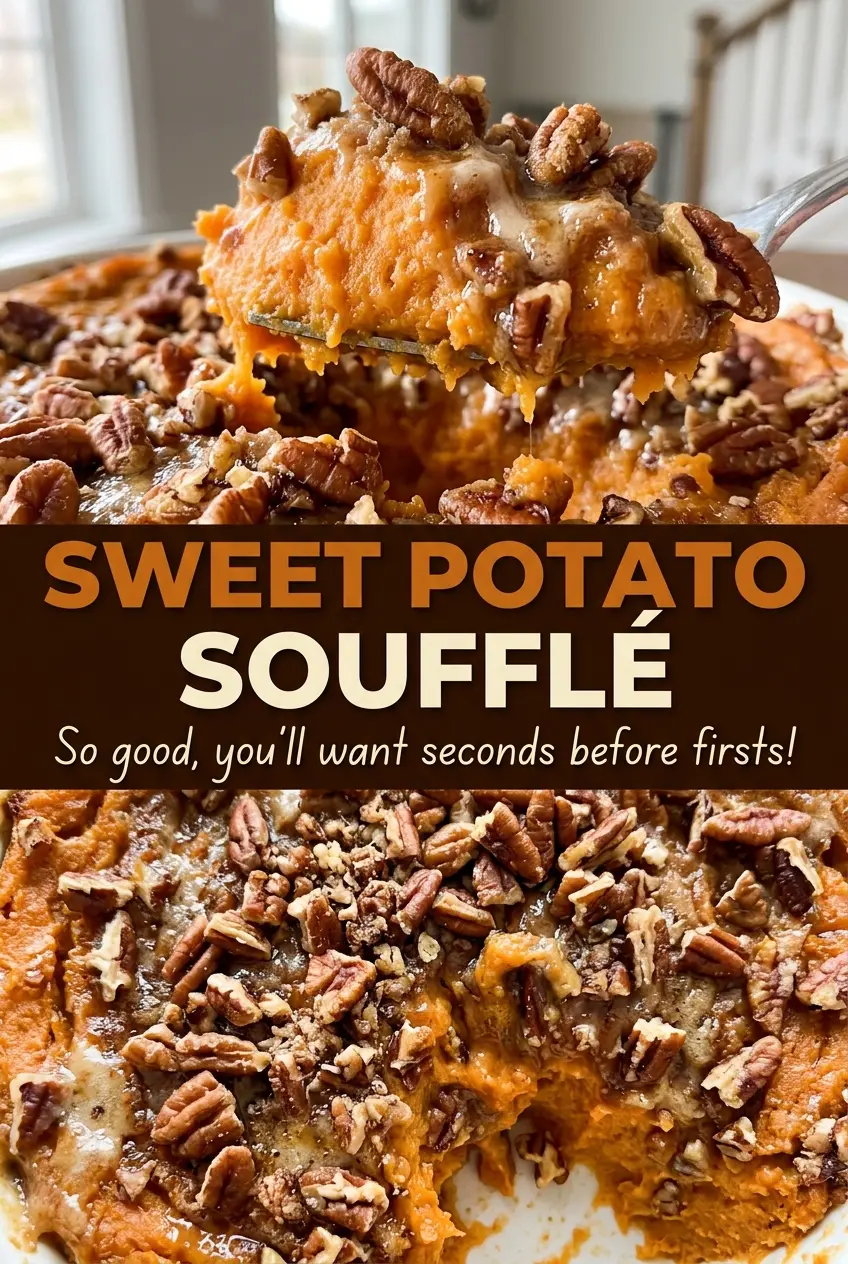
When sweet potatoes are fully baked, a knife slips through the center without resistance and the flesh scoops away from the wrinkled skins in soft, steamy pieces. That’s the first sign this Sweet Potato Soufflé is headed in the right direction. The finished dish has a smooth, gently sweet base under a crisp pecan topping, so each spoonful gets a little contrast instead of tasting like plain mashed sweet potatoes.
I like that the base comes together in one bowl after the potatoes are baked: mash the flesh, then stir in the butter, sugar, eggs, milk, vanilla, and salt. The pecan layer is a separate quick crumble, with softened butter worked into brown sugar and flour before the pecans go in. It bakes in an 8-inch square dish until the top turns golden and the center is set. The edges are soft, the topping has a pleasant crunch, and the whole pan smells like toasted pecans.
Kitchen Note
Give the pan the full 10-minute rest before serving. The base is tender straight from the oven, and that short pause lets it settle enough to scoop neatly beneath the pecan topping.
Save this Sweet Potato Soufflé for its smooth sweet potato base and crisp pecan-brown sugar topping.
Why This Sweet Potato Soufflé Stays Tender Instead of Puffing Up
The name can set up the wrong expectation: this isn’t the tall, airy kind of soufflé that depends on whipped egg whites. Here, the eggs are lightly beaten and mixed right into mashed sweet potatoes. They help the base set as it bakes, but the result is closer to a soft, spoonable casserole than a dish that climbs dramatically above its pan.
That distinction helps you judge the texture correctly. The sweet potato layer should be smooth and tender, not fluffy or dry, and the pecan topping supplies the crisp contrast. You don’t need to keep opening the oven to look for a dramatic rise. Watch for the topping to turn golden, then check the center with an instant-read thermometer; it should reach 160°F. After the short rest, the base holds together better on the spoon while staying soft.
There’s also a useful balance in the way the topping is built. Brown sugar gives it a deep, caramel-like sweetness, while flour and softened butter bind the pecans into a crumbly layer rather than a loose scatter of nuts. That crisp top makes the soft base feel complete without changing the character of the sweet potatoes.
What the Sweet Potatoes, Eggs, and Pecan Crumble Each Bring
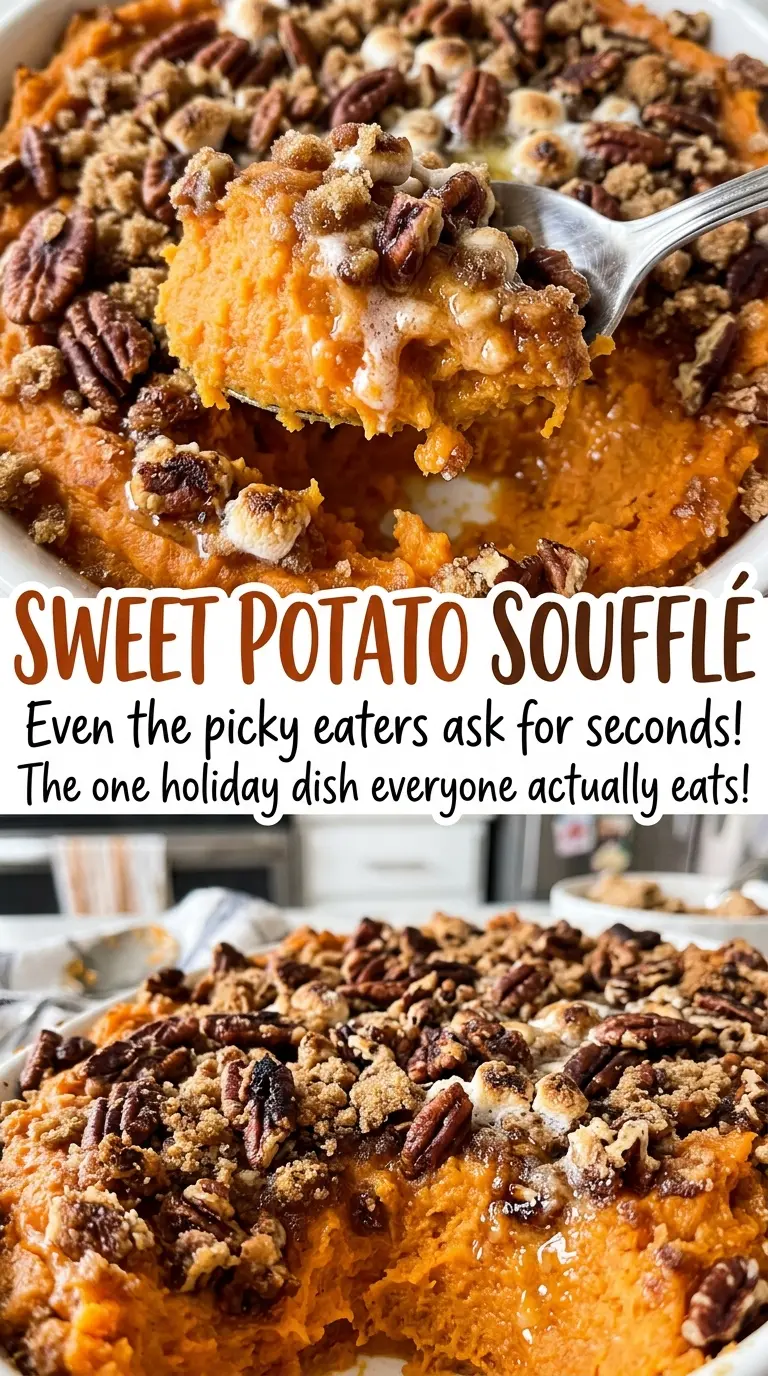
- Sweet potatoes — They’re the body and main source of sweetness in the base, so start with firm potatoes without soft spots. Baking them whole concentrates their flavor while leaving the skins easy to discard after cooking. Smaller and larger potatoes may finish at different points, so judge them by tenderness rather than the clock alone.
- Eggs and whole milk — The eggs help the mixture set, and whole milk keeps the mashed sweet potato from baking up too dense. Use eggs lightly beaten before mixing so they disperse through the base. There isn’t a direct swap in this ingredient list that gives the same set and richness.
- Unsalted butter — Butter enriches the sweet potato mixture and helps form the crumbly topping. The topping portion needs to be softened, not melted, so it can be worked through the dry ingredients. Unsalted butter also keeps the salt level from becoming harder to control.
- Granulated sugar and vanilla — These flavor the sweet potato base without taking over the pecan topping. Vanilla extract is easiest to distribute when stirred into the wet mixture. Keep the granulated sugar in the base and the packed light brown sugar in the topping; they do different jobs in the two layers.
- All-purpose flour and pecans — Flour helps the brown sugar and butter form a crumbly topping, while chopped pecans bring the distinct nutty crunch. Fresh pecans taste cleaner than nuts that have been sitting open for a long time. The topping won’t have the same texture if you leave out either the flour or the pecans.
- Kosher salt — A small amount keeps the sweet potato layer from tasting one-note. Measure it as kosher salt rather than assuming a different salt has the same grain size by volume.
From Whole Baked Potatoes to a Golden Pecan Crust
Bake the sweet potatoes until a knife slides through
Heat the oven to 400°F, scrub the sweet potatoes, and prick each one several times with a fork. Set them on a foil-lined baking sheet and bake for 45 to 60 minutes. The reliable cue is a knife that slides easily into the center; a potato that still pushes back needs more time. Let them cool until they’re easy to handle before cutting them open.
Mash the flesh into a smooth base
Scoop the cooked flesh into a large bowl and discard the skins. Mash until smooth, working out any firm pieces so the finished base doesn’t have dense lumps. Stir in the melted butter, granulated sugar, lightly beaten eggs, whole milk, vanilla, and kosher salt. Mix until the ingredients are evenly combined, but don’t keep beating once the base looks uniform.
Spread the base before building the crumble
Reduce the oven temperature to 350°F and grease an 8-inch square, 2-quart baking dish. Spread the sweet potato mixture evenly into the dish so it bakes at a consistent depth. In a medium bowl, stir together the brown sugar and flour, then work in the softened butter until crumbly. Stir in the chopped pecans, distributing them through the crumbs instead of leaving them all at the bottom of the bowl.
Bake until the center is set
Scatter the topping evenly over the sweet potato mixture, covering the surface without pressing it down into the base. Bake for 30 to 35 minutes, until the topping is golden and the center reaches 160°F. If the top looks ready before the center has reached that temperature, give the dish more time rather than relying on color alone. Rest for 10 minutes before serving so the soft base has time to settle.
Small Changes for a Different Pecan Topping
A pecan-free crumb top
Leave the pecans out if you need a nut-free version. The brown sugar, flour, and softened butter still make a crumbly top, but it will be softer and less crunchy than the pecan version. This change doesn’t make the dish gluten-free because the topping still contains all-purpose flour.
A finer, more even pecan crunch
Chop the pecans more finely for smaller bits in every bite and a topping that spreads more evenly across the dish. Keep the same ingredients and amounts; the finer pieces simply make the crust feel more integrated with the brown sugar crumble.
Storage and Reheating
- Refrigerator: Cover leftovers and refrigerate for 3 to 4 days. The topping softens as it sits against the moist base.
- Freezer: Freeze cooled portions in airtight freezer-safe containers for up to 2 to 3 months. The sweet potato base freezes well, though the pecan topping may lose some of its crunch after thawing.
- Reheating: Warm portions in a 325°F oven until heated through; reheat leftovers to 165°F. The oven helps the topping regain some texture, while a microwave heats quickly but leaves it softer.
Questions That Come Up Before This Sweet Potato Soufflé Goes in the Oven
Sweet Potato Soufflé
Ingredients
Equipment
Method
- Heat the oven to 400°F.
- Scrub the sweet potatoes and prick them several times with a fork.
- Place the sweet potatoes on a foil-lined baking sheet and bake for 45 to 60 minutes, until a knife slides easily into the centers.
- Let the sweet potatoes cool until easy to handle.
- Cut the sweet potatoes open, scoop the flesh into a large bowl, and discard the skins.
- Mash the sweet potato flesh until smooth.
- Mix in the 1/2 cup melted butter, granulated sugar, eggs, milk, vanilla, and salt.
- Reduce the oven temperature to 350°F and grease an 8-inch square, 2-quart baking dish.
- Spread the sweet potato mixture evenly in the dish.
- In a medium bowl, stir together the brown sugar and flour.
- Work in the 1/4 cup softened butter until crumbly.
- Stir in the pecans.
- Sprinkle the topping evenly over the sweet potato mixture.
- Bake for 30 to 35 minutes, until the topping is golden and the center reaches 160°F.
- Rest for 10 minutes before serving.