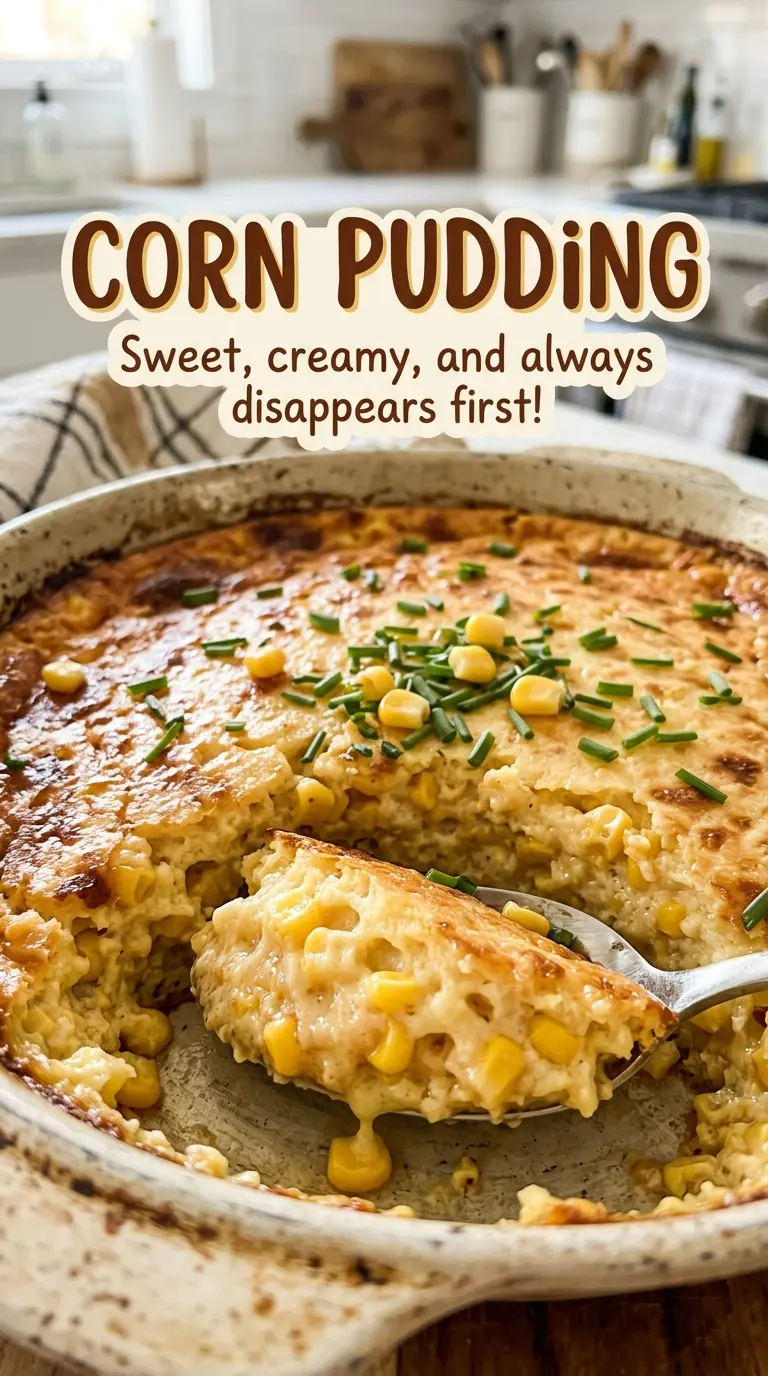
The edges of the baking dish turn pale gold before the center looks completely firm, and that contrast is part of what makes corn pudding worth waiting for. The first time I made it, I expected something closer to cornbread; this one is softer, with a tender custardy middle and a little bite from the whole kernels. It’s a comforting side that works especially well when you want something more substantial than plain corn but don’t want a fussy casserole.
The texture comes from using two kinds of canned corn rather than trying to make one do both jobs. Whole kernel corn brings distinct pops of sweetness, while cream-style corn gives the mixture a smooth, spoonable base. Eggs and a little flour help it set in the oven, so the finished corn pudding holds together without losing its soft center.

Kitchen Note
Before baking, the mixture looks loose and much more like a pourable batter than a finished casserole. Resist the urge to add extra flour; the eggs and flour thicken it as it bakes.
Save this corn pudding for a cozy, custardy side with golden edges and sweet whole kernels in every spoonful.
Why Corn Pudding Isn’t Supposed to Bake Up Like Cornbread
Corn pudding doesn’t have a leavener to make it rise into a fluffy, sliceable bread. It’s built more like a savory custard: eggs give it structure, milk keeps the center tender, and the flour helps the mixture set without turning it dense. That’s why a soft center is welcome here, while a dry, bready texture means the dish has gone too far in the oven.
The two corn varieties also affect the finished texture in different ways. Whole kernel corn gives you a clear bite of corn in each spoonful, but those kernels alone would leave a much less cohesive dish. Cream-style corn brings its own thick, creamy base, so the pudding stays moist and holds together once baked. Keeping both in the mixture gives you contrast instead of a uniform mash or a loose custard.
Think tender casserole, not firm cornbread. The center should be just set rather than stiff, and the edges should be lightly golden. That balance lets the corn stay prominent without making the pudding feel heavy.
What the Canned Corn and Custard Ingredients Each Bring
- Whole kernel corn — Regular canned corn works well here; there’s no need to seek out a specialty variety. Drain it thoroughly so extra canning liquid doesn’t loosen the mixture, and keep the kernels intact for their distinct texture.
- Cream-style corn — This is the creamy part of the base, so don’t drain it. It’s a different product from a can of regular corn, and swapping in more whole kernels won’t give the same soft, cohesive result.
- Eggs — Large eggs provide the set that turns the liquid mixture into pudding. Use them as listed rather than cutting back; fewer eggs would leave the center less structured.
- Whole milk and unsalted butter — Together they bring richness and keep the baked texture tender. Unsalted butter gives you control over the seasoning, and ordinary whole milk is the right choice for the intended consistency.
- All-purpose flour — The small amount helps the egg mixture hold the corn evenly. Whisk it with the sugar, salt, and pepper first so the dry ingredients are distributed before they meet the wet mixture.
- Granulated sugar, kosher salt, and black pepper — The sugar gently rounds out the corn’s sweetness, while salt and pepper keep the dish from tasting one-note. The pepper stays subtle rather than making the pudding spicy.
Building the Mixture So It Bakes Into a Tender Pudding
Prepare the Dish and Separate the Mixtures
Heat the oven to 350°F and grease a 2.5-quart baking dish with nonstick cooking spray. In a medium bowl, whisk the flour, sugar, kosher salt, and ground black pepper until evenly combined. In a larger bowl, whisk the eggs with the whole milk and melted butter. Having the two mixtures ready separately makes it easier to blend the flour in smoothly.
Whisk Until Smooth, Then Add Both Corns
Whisk the flour mixture into the egg mixture until you no longer see dry pockets or small flour clumps. Take a moment to get the base smooth before adding the corn; kernels make it harder to spot and break up lumps. Stir in the drained whole kernel corn and the cream-style corn until they’re distributed through the mixture. The batter will still be loose at this point.
Pour and Bake Until the Center Sets
Pour the mixture into the prepared baking dish and bake for 50 to 60 minutes. Look for lightly golden edges and a center that has just set rather than puffed and firmed all the way through. Check the center with a food thermometer; it should reach 160°F. If the edges look ready before the center does, use the center reading to judge doneness.
Rest Before Serving
Let the dish rest for 10 minutes before serving. This short pause gives the warm custard time to settle, making it easier to scoop without expecting it to cut like a firm bread. Serve it warm, when the center is tender and the whole kernels still stand out.
Three Useful Ways to Adapt Corn Pudding
Make It Gluten-Free With a 1:1 Flour Blend
Replace the all-purpose flour with the same amount of a gluten-free flour blend labeled as a 1:1 substitute for baking. The pudding may feel a touch softer, but the blend still gives the egg mixture enough body. Avoid using almond or coconut flour as a direct swap; they absorb liquid differently.
Use Dairy-Free Milk and Butter
For a dairy-free version, use unsweetened oat milk in place of the whole milk and a dairy-free butter substitute in place of the unsalted butter, keeping the same amounts. Choose an unflavored milk so it doesn’t add sweetness or a strong taste. The result is a little less rich, but the eggs and corn still give it a tender, set texture.
Give the Corn a Smoother Texture
For a less chunky pudding, briefly pulse about half of the drained whole kernel corn before stirring it into the mixture, then add the remaining kernels whole. You’ll keep some pops of corn while blending more of its texture into the base. Don’t blend all of the corn if you still want distinct kernels in each serving.
Storage and Reheating
- Refrigerator: Refrigerate leftovers within 2 hours, covered, for 3 to 4 days. The cold pudding firms up, then softens again as it warms.
- Freezer: Freeze cooled portions in an airtight container for up to 2 months. Thaw them in the refrigerator; the texture may be a little less smooth after thawing.
- Reheating: Warm covered portions in a 325°F oven until heated through to 165°F, or reheat a single portion in the microwave. Avoid overheating, which can make the egg-based center rubbery.
Questions That Come Up When Making Corn Pudding
Corn Pudding
Ingredients
Equipment
Method
- Heat the oven to 350°F and grease a 2.5-quart baking dish with nonstick cooking spray.
- In a medium bowl, whisk together the flour, sugar, salt, and pepper.
- In a large bowl, whisk the eggs, milk, and melted butter.
- Whisk the flour mixture into the egg mixture until smooth.
- Stir in the whole kernel corn and cream-style corn.
- Pour the mixture into the prepared dish and bake for 50 to 60 minutes, until the edges are lightly golden, the center is just set, and the center reaches 160°F.
- Let the corn pudding rest for 10 minutes before serving.